Systemization vs. Automation


Most businesses confuse systemization with automation — and it’s costing them time, money, and momentum. They sound similar. Both involve process structure. Both promise efficiency. But that’s where the similarity ends.
Systemization is about creating the structure — documenting how work actually happens, who owns what, and how pieces connect. It’s the playbook.
Automation is about executing that structure — making the documented process run on triggers and tools instead of manual effort. It’s running the playbook.
One builds the process. One automates it. You can’t automate what hasn’t been defined.
That’s where most businesses get it backwards. They automate before they’ve systemized. The tools execute what’s there — and what’s there is chaos dressed as operations.
Automation didn’t fail. The order of operations did.
The System Maturity Pyramid
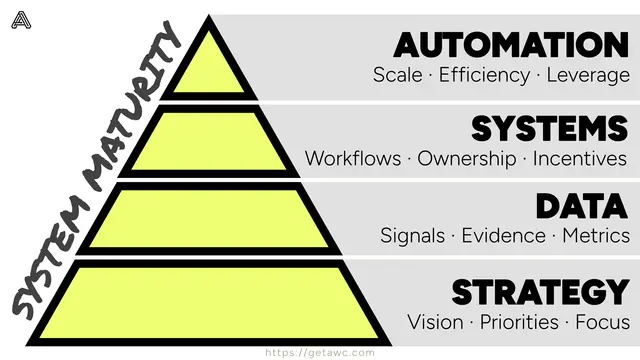
Automation doesn’t sit at the foundation. It sits at the top — and depends on everything beneath it. Here’s what the full stack looks like:
1. Strategy
Vision, priorities, focus. What game are you playing? What actually matters?
2. Data
Signals, evidence, metrics. You can’t improve what you can’t see. If the numbers don’t tell you where things break, you’re guessing.
3. Systems
Workflows, ownership, playbooks. Processes are documented. Handoffs are defined. The business runs the same whether you’re there or not.
4. Automation
Scale, efficiency, amplification. Triggers fire. Data flows. The software does the repetitive work — but only because the three layers beneath it are solid.
Skip a layer and the whole thing crumbles. Automate without systems and you get faster chaos. Systemize without data and you’re optimizing blind. Gather data without strategy and you’re measuring noise.
A lot of businesses start at the top and work down. That almost never works.
Document. Optimize. Automate. In That Order.
The sequence is non-negotiable. You cannot automate what hasn’t been documented. You cannot document what you haven’t examined. Most businesses skip straight to step three.
Document first. Write down how the work actually happens — not how you think it happens. Map the handoffs between people and between tools.
Capture the exceptions. Identify where data gets re-entered and where decisions depend on one person’s judgment.
Then optimize. Remove steps that don’t add value. Close the gaps between tools. Make the process produce the same result regardless of who executes it.
Test it. Refine it. Make it boring and predictable.
Then — and only then — automate the repetitive steps within it. Triggers replace the manual handoffs. Data flows where it should without someone copy-pasting it. The automation amplifies what’s already working.
When you skip to automation, you layer fragility on top of fragility. The tool executes ambiguity. When the process changes — which it will, because it was never stable — the automation breaks and nobody knows why, or you burn cycles updating your automation to keep up with the changes.
Ready to build your own systems? Here’s the complete framework for systemizing a business.
Automating a Broken Process Makes a Faster Broken Process
This isn’t opinion. McKinsey reports that roughly 70% of automation and digital transformation initiatives fall short of expected results. 1 The Standish Group finds only 31% of IT projects fully succeed. 2 These aren’t technology problems.
Bain & Company identifies that 72% of transformation failures are due to managerial reasons — insufficient leadership support and employee resistance — not technical problems. 3 When automation fails, businesses blame the tool. But the tool was never the problem.
The problem was that nobody wrote down how the work actually happens. Nobody owned the process end-to-end. The automation was asked to execute ambiguity. It can’t. No tool can.
47% of process automation projects fail due to incomplete documentation. 4 And 71% of company know-how is undocumented — it lives in people’s heads. 5 You can’t automate what was never written down. Most businesses try anyway.
Most businesses automate before they systemize. The result isn’t faster growth — it’s faster chaos. If this pattern sounds familiar, take our free five-minute assessment. See where your systems actually stand before you touch another tool.
What Systemization-Ready Looks Like
Before automation touches anything, the process must pass five tests. A practical checklist from businesses that got this right.
- The process is written down — in a system, not someone’s head.
- One person is accountable for it end-to-end.
- It produces the same result regardless of who executes it.
- The handoffs between functions are explicit: this happens, then that happens, and here’s how data passes between them.
- The process is measured — you know whether it’s working or breaking.
If a process doesn’t meet these five conditions, automation will make it worse. Not better. Just faster — and harder to fix when it breaks because now the mess is buried under tooling.
This isn’t perfectionism. It’s readiness. You don’t need every process to be flawless. You need them to be defined, owned, consistent, connected, and visible. Those are the prerequisites. Without them, automation is just acceleration without direction.
The Compounding Sequence
When systemization comes first, automation amplifies what works. Documented processes become automated workflows. Clear handoffs become trigger-based routing. Measured processes become dashboards. You scale without adding proportional headcount or complexity.
Shannon Smit of Smart Business Solutions spent six to seven years building documented processes before implementing automation. 6 One automated process now saves 998 hours annually. The systems came first. Automation was the natural next step — not a rescue mission.
Michael Gerber diagnosed this decades ago in The E-Myth Revisited: “If your business depends on you, you don’t own a business — you have a job.” 7 His distinction between working IN the business and ON the business explains why the sequence matters. Systemization is working ON the business. Automation without it is just working IN it faster.
Gino Wickman’s Traction calls the Process Component “the most neglected of the Six Key Components” — yet it’s the prerequisite for everything else. 8 Simplicity. Efficiency. Profitability. They all depend on defined processes, not faster tools. Build the systems. Then let the automation amplify them.
When You Get the Order Right
When you get the order right — systemize first, automate second — your business changes in specific, operational ways. Not in theory. In how the day actually goes.
Work becomes visible. You can see where a project is without opening six tabs and asking three people. Handoffs stop depending on you. When a client moves from sales to delivery, the right information follows automatically. Your people know what to do next without routing through you.
Your best people do the work they were hired for — not the busywork the disconnected systems create. Data flows where it should. Tools talk to each other.
The software does what it was supposed to do when you bought it.
Growth stops being the thing that exposes hidden fragility. It becomes something you pull intentionally. Add an account without adding chaos. Scale without adding coordination overhead. Build without the business breaking under its own weight.
The business doesn’t depend on one person anymore — not because you automated away the people, but because the system is clear enough that anyone can execute it. You stop being the safety net. The playbook does that work.
Ready to stop automating chaos? Take our free five-minute assessment. We’ll show you exactly where your systems stand — and what needs to be systemized before you touch another tool.
References
- [1] McKinsey & Company. "Unlocking success in digital transformations." Reports fewer than one-third of organizations succeed at digital transformation — roughly 70% fall short of objectives.. ↩
- [2] The Standish Group, CHAOS Report. Only 31% of IT projects fully succeed (on time, on budget, with required features).. ↩
- [3] Bain & Company, transformation outcomes research.. ↩
- [4] Scribe, Scribe ROI Report, 2025.. ↩
- [5] Scribe, Scribe ROI Report, 2025. Survey of 1,000+ business leaders.. ↩
- [6] Shannon Smit, Smart Business Solutions, via systemHUB.. ↩
- [7] Michael Gerber, The E-Myth Revisited, HarperBusiness, 1995.. ↩
- [8] Gino Wickman, Traction, BenBella Books, 2012.. ↩
What to read next

systemization
What Is Business Systemization? Understanding Your Business as a Living System
Systemization isn't writing SOPs or connecting tools. It's the practice of seeing your business as a system of functions — and designing the connections that make the whole thing work.

systemization
What Is Operational Debt?
Operational debt is the cost of every shortcut your business never went back to fix. It compounds daily. Here's where it hides, what causes it, and how to start paying it down.

systemization
How to Systemize a Business: The Complete Guide
Systemization isn't writing more SOPs or buying more software. It's building operations that are repeatable, visible, and independent of any single person. Here's the framework.

systemization
Hero Culture and Operational Fragility
Most people call it a great culture. It's actually a single point of failure. When one person is the answer to every question, the business doesn't have operations — it has a hero. And that's a systems problem, not a people problem.